

Oil purifiers are designed to quickly remove water, dissolved gases, and solid particles from oil. Clean oil ensures smooth system operation and reduces the likelihood of costly failures, extending system life and improving overall performance.
We offer a range of oil purifiers that are highly appreciated by our customers for their efficiency in removing contaminants from hydraulic, lubricating and turbine oils. Even for the most extreme applications, there are no limits to our custom filtration solutions.
Why Choose Us
Excellent Quality
We use industry leading technology and international quality standards to manufacture our filtration products.
Competitive Price
We offering a higher-quality product or service at an equivalent price. As a result we have a growing and loyal customer base.
Support Customization
Many of the industrial filtration products we offer can be customized to meet specific industry requirements.
Ship Globally
As a manufacturer, we ship directly to customers worldwide, saving costs and shortening lead times to customers.


The essential components of an oil purifier
An oil purifier is mainly composed of several key components working together to complete the task of oil filtration and purification. These components include, but are not limited to, heating systems, filtration systems, vacuum systems, oil supply systems, and control systems. Here's a closer look at each of the main components:
Heating system
The heating system is responsible for heating the oil to be filtered to the right temperature. By heating, impurities and moisture are more easily separated and removed. Heating systems typically consist of heaters, temperature sensors, and thermostats to ensure that the oil is filtered within the optimal temperature range.
Filtration system
The filtration system is the core component of the oil purifier and is used to remove impurities and contaminants from the fluid. It is usually composed of a filter element, a housing, an oil pump and a fixture. The filter element is mostly made of metal mesh or fiber material, which can effectively filter out contaminants such as fine particles, fibers, and gum.
Vacuum system
Some products are also equipped with a vacuum dehydration system, which uses the principle of vacuum negative pressure to evaporate tiny water droplets and gases from the oil, further improving fluid purity. Vacuum systems typically include components such as vacuum pumps, condensers, etc., which are effective in removing moisture and volatile substances.
Oil supply system
The oil supply system is responsible for transporting the fluid to be filtered into the filtration equipment. It usually consists of oil pumps, pipelines, valves, and other components. The oil pump is the core equipment of the oil supply system, usually using a gear pump, which can make the fluid circulate and ensure that the fluid is evenly treated during the filtration process.
Control system
The control system is responsible for the operation control and monitoring of the entire oil purifier. It is usually composed of controllers, sensors, switches, indicators and other components, which can realize automatic control and remote monitoring. The control system can monitor the temperature, pressure and other parameters of the oil, and automatically stop the alarm in abnormal cases to ensure the safe operation of the equipment.
Other accessories
In addition to the above main components, the oil purifier also contains many auxiliary parts, such as safety valves, check valves, control valves, oil pans, pressure gauges, wheels, etc. These components work together to ensure efficient and stable operation.
What are the characteristics of oil purifier?
features
- Cost effective filtration.
- A variety of filter elements are available to meet different needs.
- Heavy-duty frame, sturdy and durable.
- Wheeled design, easy to move and carry.
- With fully customizable filtering options.

benefits
- Improve fluid quality and cleanliness.
- Extend fluid and system life.
- Reduce the need for frequent oil changes and reduce maintenance and repair costs.
- Reduce downtime due to equipment failure.
- Reduce the amount of waste generated and avoid environmental pollution.

Our workshop
Our extensive experience and advanced manufacturing capabilities mean that there are no limits to our custom filtration solutions for even the most extreme applications.


Typical applications for oil purifier
Iron and steel, Metallurgical industry
Used for oil purification of hydraulic systems and gearboxes.
Petrochemical, Marine, Railway
Oil filtration of lubrication system to improve equipment efficiency and life.
Power industry
Maintenance and treatment of transformer oil to ensure the stable operation of power equipment.
Manufacturing, Cement, Power generation
Routine maintenance and deep purification of various industrial oils.
Mining, Machinery, Chemical industry, Textile
Handle contaminated lubricating oil, hydraulic oil, etc., to ensure the normal operation of the equipment.
Transportation industry
It is used to purify diesel fuel on a regular basis to prevent wear and failure of machinery and equipment.
How to choose the right oil purifier?
When choosing an oil purifier, the following core elements should be considered:
Type of fluid
Choose the appropriate product according to whether the oil is corrosive, whether the viscosity is too high, whether it is flammable and explosive, etc. For example, for corrosive fluids, stainless steel filter elements should be chosen. For high-viscosity fluids, it is necessary to select equipment consisting of high-viscosity pumps, and choose whether a heating system is required according to the actual situation.
Type of contaminant
The model and function of the oil purifier should match the type of contaminants that need to be filtered. For example, if dewatering and impurity removal are required at the same time, a coalescing type oil purifier or a high vacuum oil purifier can be selected.
Working conditions
Select the oil purification system based on the temperature of the material to be processed, the amount of treatment and the environment in which the equipment is placed (indoor or outdoor). In high-temperature environments, it is necessary to choose products with high temperature resistance and explosion-proof functions.
Cost-effective
Consider the cost-effectiveness of the oil purifier to avoid excessive pursuit of low prices and affect product quality. You can refer to the advice provided by AYATER to choose a cost-effective product.
Oil purifier maintenance tips
The maintenance tips of the oil purifier are the key to ensure its long-term stable operation, improve the filtration efficiency and extend the service life. Here are some important maintenance tips:
Wash regularly
Cleaning cycle: According to the frequency of use of the oil purifier and the degree of fluid pollution, formulate a suitable cleaning cycle. It is generally recommended to perform a thorough cleaning after a period of operation (e.g., weeks or months).
Cleaning method: Use a special cleaning agent and operate according to the requirements of the equipment manual. During the cleaning process, contaminants should be thoroughly removed to ensure the filtration effect and working performance of the equipment.
Replace the filter element regularly
Replacement cycle: The filter element is a very critical component in the oil purifier, which directly affects the filtration effect. After a long period of use, the element can clog or lose its filtration capacity, so it needs to be checked and replaced regularly. The specific replacement cycle can be determined according to the recommendations of the use case and the equipment manual.
Precautions: When replacing the filter element, pay attention to choosing the appropriate specifications and materials to ensure that it matches the equipment. At the same time, it is necessary to pay attention to the operation specifications during the replacement process to avoid damage to other components.
Check the sealing performance
Inspection content: Regularly check the seals of the equipment (such as interface seals, oil seals, etc.) to ensure that there is no leakage. Once a leak is found, it should be dealt with in time to prevent oil contamination and waste.
Solution: For minor leaks, it can be solved by tightening the seal or replacing the gasket. For severe leaks, the entire sealing part needs to be replaced.
Lubrication and maintenance
Lubrication: Some key components (such as bearings, gears, etc.) need to be lubricated and maintained to reduce friction and wear.
Lubrication method: According to the requirements of the equipment manual, select the appropriate lubricant and lubrication method. In general, lubrication maintenance can be carried out by regularly refueling or changing the lubricating oil.
Electrical system inspection
Inspection content: Regularly check the electrical system (such as motors, relays, etc.) to ensure that the electrical components are not damaged, and the electrical circuits are not loose or short-circuited.
Solution: For damaged electrical components, replace them in time. Regularly check the insulation performance of the electrical system to ensure the safe operation of the equipment.
Safe operation
Operation specifications: When maintaining the oil purifier, it is necessary to comply with the relevant operating procedures and safety operation specifications.
Shutdown inspection: In the process of maintenance, if there is an equipment failure or abnormal situation, it is necessary to stop the machine for inspection in time and take corresponding treatment measures.
Our Factory
Ayater Filtration is a manufacture filtration and separation products for applications across many sectors including the Oil and Gas industry, food & beverage, pharmaceutical, biotech, pulp & paper, mining, manufacturing, power generation, agriculture, marine, and so on.
AYATER strives to provide outstanding value with exceptional customer service, excellent product expertise and technical support, and industry-leading and competitively priced products that are in stock on time.

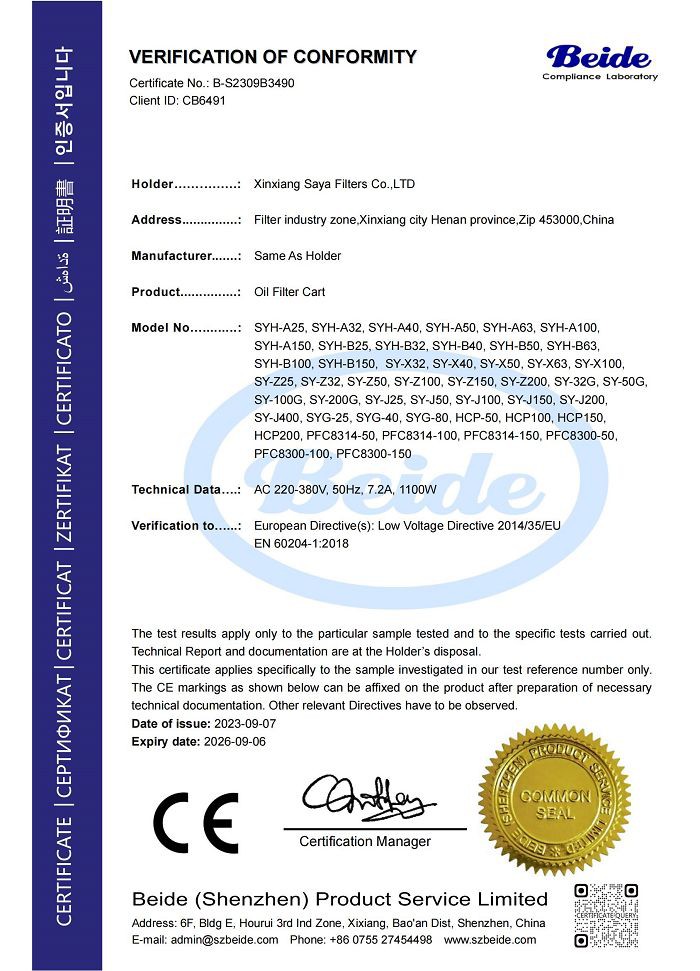
Certifications




FAQ
Q: What is an oil purifier?
A: Oil purifier is designed to remove water, dirt, and solid particles from oil, thereby improving oil quality and extending service life.
Q: What types of oil can be cleaned with an oil purifier?
A: Able to clean various types of oils such as hydraulic oil, lubricating oil, transformer oil, etc.
Q: How does an oil purifier work?
A: Make it cleaner and more effective to use by using filtration and other advanced techniques to remove impurities, contaminants, water, and other unwanted particles from the oil.
Q: What are the benefits of using an oil purifier?
A: Benefits include longer machine life, increased efficiency, and reduced downtime due to component failure caused by dirty oil.
Q: How often should an oil purifier be used?
A: The frequency of use may vary depending on the type of oil, application, and degree of contamination. In general, regular use is recommended to maintain maximum efficiency.
Q: How long does it take to clean oil with an oil purifier?
A: The time it takes to clean the oil can vary depending on the type of oil and the degree of contamination. However, most products can clean the oil within a few hours.
Q: Do I need to change the oil after cleaning with an oil purifier?
A: No, it is not always necessary to change the oil after cleaning with an oil purifier. However, it is recommended if the oil is heavily contaminated or has degraded performance.
Q: Can an oil purifier remove all types of contaminants from oil?
A: Most contaminants from the oil, including solid particles, water, and sludge, can be removed. However, some contaminants, such as acids and dissolved gases, may require additional treatment.
Q: How much does an oil purifier cost?
A: The cost of an oil purifier can vary depending on the type, size, and function of the machine. It's best to check with the manufacturer or supplier for specific pricing information.
Q: What are the maintenance requirements for oil purifier?
A: Maintenance requirements include regular cleaning and replacement of filter elements, inspection and replacement of gaskets, regular inspection of electrical components, and monitoring of the machine's performance.
Q: Does the oil purifier require any special training to operate?
A: Yes, some basic training is recommended to ensure safe and effective use. This training may include an understanding of equipment components, operating procedures, and maintenance requirements. These can be learned in the product operator's manual.
Q: Can the oil purifier be customized for a specific application or environment?
A: Yes, additional features can be customized. Such as preheaters, water sensors or alarms to accommodate extreme temperatures, pressures or humidity.
Q: Can oil purifiers be used on high viscosity oils?
A: Yes, it can be used to filter high viscosity oils. However, it is important to choose an oil purification system that is specifically designed to handle high-viscosity oils.
Q: Can an oil purifier run continuously?
A: Yes, some models are designed for continuous operation, while others may require periodic shutdown for maintenance.
Q: How long can an oil purifier last?
A: This depends on a variety of factors, such as the quality of the components, the frequency and intensity of use, maintenance and cleaning practices, and environmental conditions. If any problems arise, you must consult AYATER's technical staff immediately.
Q: Can an oil purifier remove water from oil?
A: Yes, moisture can be removed. A water separation unit can be configured specifically for water removal.
We're professional oil purifier manufacturers and suppliers in China, specialized in providing high quality customized service. We warmly welcome you to buy oil purifier in stock here from our factory. For price consultation, contact us.