

Turbine oil purifiers are designed to treat contaminated turbine oil using filtration, vacuum, or coalescing techniques. Turbine oil is easily contaminated with harmful pollutants such as air, water and solid particles during transportation and storage, and if not removed in time, it may lead to damage to the entire system. By combining these advanced technologies, these specific contaminants can be effectively removed, keeping fluids clean and dry.
Why Choose Us
Excellent Quality
We use industry leading technology and international quality standards to manufacture our filtration products.
Competitive Price
We offering a higher-quality product or service at an equivalent price. As a result we have a growing and loyal customer base.
Support Customization
Many of the industrial filtration products we offer can be customized to meet specific industry requirements.
Ship Globally
As a manufacturer, we ship directly to customers worldwide, saving costs and shortening lead times to customers.


Product Components
Coarse Filter
Primarily relies on an internally mounted oil filter element to function and is designed to intercept larger solids particles to protect subsequent equipment from damage.
Vacuum System (Optional)
In the vacuum state, the fluid is evenly heated by a heater, and the water will evaporate into water vapor. After that, it enters the condenser and is discharged as liquid water.
Coalescing System (Optional)
The coalescing filter element and the separation filter element are used to condense the water molecules into larger water droplets to achieve the oil-water separation state.
Fine Filter
Typically used in the subsequent filtration stage. A high-precision filter element is installed inside to remove any fine particles that fail to be removed during the initial filtration phase.
Control System
Used to control the start, stop, heating temperature and other parameters of the oil purifier. Provide PLC intelligent control to achieve automatic continuous operation.
Ancillary Accessories
Includes pressure gauges, thermometers, flow meters, and other specified accessories. Different products have different configurations and can be selected according to specific needs.
How it works
Turbine oil purifiers mainly work based on technologies such as vacuum dehydration, coalescence separation, and filtration. By combining these advanced technologies, multi-stage filtration is achieved to effectively remove water, debris, and other harmful contaminants. Here's how it works:
- Coarse Filter - After the equipment is started, the contaminated fluid enters the coarse filter through the hose under the action of atmospheric pressure, and large particles of impurities are removed.
- Dewatering System - The preliminarily filtered fluid enters a vacuum dehydration system or coalescing separation system to remove the water in it by heating or coalescing.
- Fine Filter - The fluid after water removal enters the fine filter and passes through the fine pore size filter element to remove the tiny impurities and contaminants that were not removed in the first stage.

The above only shows the flow diagram of the vacuum dehydration system. When it comes to vacuum heating systems and coalescing separation systems, most users don't know what to choose. The vacuum heating system is mainly used to remove dissolved water, and the coalescing separation system is used to remove free water. You can choose the right water removal system based on factors such as the type of water pollution and the amount of water.

Ayater's turbine oil purifier
| Features |
Benefits |
|
Using vacuum or coalescing technology, it has excellent dehydration and demulsification effect. |
Double water and particle removal. |
|
The deep precision filter element is used to remove particles with high efficiency. |
Significantly improve the purity grade of fluids. |
|
It is equipped with an interlock protection device, which can realize automatic online operation. |
Effectively extend the service life of fluids and systems. |
|
The new electric heating system ensures balanced heating and low energy consumption. |
Reduce the probability of downtime due to equipment failure due to oil contamination. |
|
Equipped with a reliable medium condensing device, the cooling rate is fast. |
Cost-effective and sustainable with low maintenance costs. |
|
Freestand-stand, skid-mounted, stationary or portable systems are available. |
It is suitable for filtering low-viscosity fluids such as turbine oil, hydraulic oil, lubricating oil. |
Be used in a wide range of industries.

Power Generation Facilities

Paper Industry

Oil Refineries

Automotive Industry

Metallurgical Industry

Marine Industry
Selection guide
When choosing a turbine oil purification machine, the following key factors must be considered.
Application requirements
- Fluid Type: Different fluids may have different viscosities and contaminant contents. The right equipment needs to be selected based on the type of fluid being handled to ensure maximum effectiveness.
- Types of Contaminants: Know the main types and levels of contaminants present in your fluids, such as solid particles, debris, varnish, moisture, gases, and more. Different contaminants require different micron ratings and configurations.
- Throughput: Represents the amount of traffic that can be processed per unit of time. Different applications have different traffic requirements, which need to be determined based on the actual situation. Avoid being too large or too small to cause waste of resources or poor treatment results.
Product performance
- Micron Rating: This represents the ability to effectively remove particulate contaminants and is typically related to the pore size of the filter element. Selecting the right micron rating for your specific needs ensures the removal of any solids and improves fluid cleanliness.
- Dehydration Efficiency: Mainly achieved by vacuum heating, coalescence separation and other technologies. The choice of dewatering efficiency depends mainly on the amount of water content. If the contaminated fluid contains a large amount of water, a configuration with high dewatering efficiency needs to be selected.
- Durability and Stability: Choose products made from the best materials and optimized for construction to ensure robustness to ensure long-term stable operation and reduce maintenance costs.
Device configuration
- Heating System: At low temperatures, the fluidity of the fluid is poor. Equipment with a heating system is selected to improve flowability.
- Control System: If you want to monitor the operation status of the equipment in real time, you need to choose the equipment with a PLC control system to provide automatic operation operation.
- Auxiliary Parts: Including pressure gauges, thermometers, valves, etc. If you need to specify accessories, you should communicate with the technician when designing the product.
On-site conditions
- Ambient Temperature: Different types of turbine oil filter machines need to be selected at different temperatures. In a high-temperature environment, it is necessary to choose equipment made of high-temperature resistant materials; In a low-temperature environment, where fluid flow is poor, it is necessary to choose a product with a heating function.
- Placement Environment: In the indoor environment, ordinary equipment is enough to use; However, in the outdoor environment, it is generally recommended to choose equipment with a canopy, which has the effect of weatherproofing.
- Working Pressure: Represents the ability of the equipment to work stably under various pressure conditions. Usually the working pressure of the equipment should be greater than the working pressure of the system to ensure the smooth passage of the fluid.
Professional manufacturer
- Production Experience: Choose a manufacturer with many years of production experience to provide high-quality and tested products.
- Customer Evaluation: Through customer evaluation and feedback results, you can understand the actual effect and performance of the product.
- Technical Support: Choose a manufacturer that can provide technical support and after-sales service so that any filtration issues can be resolved at any time.
Production workshop


Our Factory
Ayater Filtration is a manufacture filtration and separation products for applications across many sectors including the Oil and Gas industry, food & beverage, pharmaceutical, biotech, pulp & paper, mining, manufacturing, power generation, agriculture, marine, and so on.
AYATER strives to provide outstanding value with exceptional customer service, excellent product expertise and technical support, and industry-leading and competitively priced products that are in stock on time.

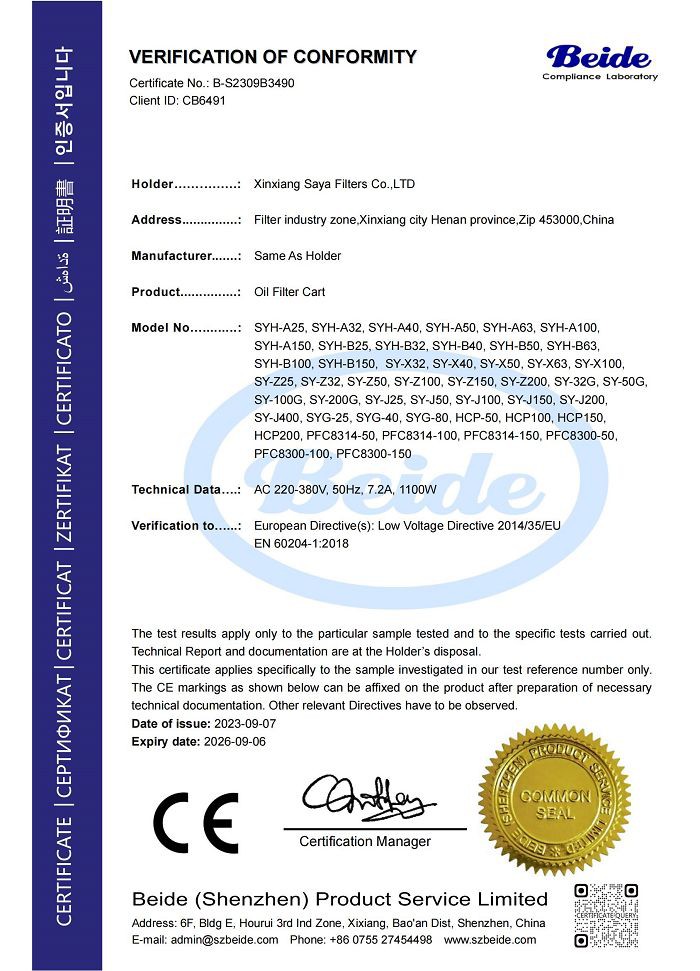
Certifications




Ordering process
Our email: sales@ayater.com; Phone: +8615137365449
Send Inquiry
1
>>
Communicate the Details
2
>>
Provide a Quote
3
>>
Sign the Contract
4
>>
Start of Production
5
>>
Outbound Inspection
6
FAQ
Q: What is turbine oil good for?
A: It plays the role of lubrication system, anti-rust and anti-corrosion.
Q: What are the common contaminants in turbine oil?
A: Water, rust, oxidation products, debris, gases, etc.
Q: What are the benefits of turbine oil purification?
A: Avoid wear and tear caused by oil contamination and extend the service life of equipment and its components, thereby protecting turbine systems.
Q: What is the main function of turbine oil conditioning system?
A: Removes water, solid particles, and other harmful contaminants from turbine oils to improve fluid cleanliness.
Q: How does a turbine oil purifier work?
A: It typically utilizes a multi-stage filtration process to remove any contaminants. This is achieved through advanced filtration technology, vacuum heating technology, coalescence technology, etc.
Q: How long does the filtration process take?
A: It usually takes a few hours to complete. The exact time depends on the type of machine used and the flow rate.
Q: How to use a turbine oil filtration machine?
A: 1. Turn on the power and check whether the steering of the oil pump is correct.
2. Open the inlet and outlet valves to suck the contaminated oil into the equipment.
3. Observe the value of the pressure gauge to ensure that the equipment is running under normal working pressure.
4. Adjust the heating temperature and filtration time as needed, and carry out multiple cycle filtration to completely remove water and particles.
5. After the filtration is over, turn off the equipment in order, and clean up the accumulated impurities and replace the filter element.
Q: What role does the vacuum system play in this equipment?
A: It mainly plays the role of dehydration.
Q: How to maintain a turbine oil purifier?
A: This includes regular cleaning of filter elements and replacement of wearing parts, checking whether the electrical system is safe and stable, and establishing a sound troubleshooting and handling mechanism.
Q: Can turbine oil filter machines be used for other fluids?
A: Yes, such as hydraulic oil, lubricating oil, etc.
Q: Is explosion-proof design available?
A: Yes, if you need it.
Q: How do I get a quote?
A: Send your inquiry to our mailbox or call us directly.
Q: Is the customized plan available for free?
A: Yes, our technicians can provide free customized service according to your drawings or specific needs.
Q: How to ensure product quality?
A: After the production of the product is completed, take a photo and send it to the customer for confirmation; Professional testing before leaving the factory to verify filtration performance and ensure consistent quality.
We're professional turbine oil purifier manufacturers and suppliers in China, specialized in providing high quality customized service. We warmly welcome you to buy turbine oil purifier in stock here from our factory. For price consultation, contact us.
high vacuum turbine oil purifier machine, coalescer type turbine oil purifier, turbine oil purification system