

Oil filter carts are a portable way to filter multiple types of new and used oil, take oil samples, and transfer oil to and from storage containers and machines. Oil filter carts are now considered a necessity when it comes to having an effective lubrication program thanks to their many benefits and uses.
Why Choose Us
Excellent Quality
We use industry leading technology and international quality standards to manufacture our filtration products.
Competitive Price
We offering a higher-quality product or service at an equivalent price. As a result we have a growing and loyal customer base.
Support Customization
Many of the industrial filtration products we offer can be customized to meet specific industry requirements.
Ship Globally
As a manufacturer, we ship directly to customers worldwide, saving costs and shortening lead times to customers.


How To Select The Right Filter Cart?
Check the type of oil before buying a filter cart because carts are designed as per the viscosity levels. If a plant uses different types of oil then multiple filter carts are to be used.
Choose a filter cart that can be carried easily to the place of its application. Here, you have to consider the source of power as well.
Knowing your oil cleanliness target is very important before you buy filter carts. Don’t depend on the ISO standards entirely to evaluate used oil. Considering the specification of the type of oil is vital. We know that when viscosity increases, the cleanliness level decreases.
Check the oil flow rate. Powerful carts will cost you more, so it’s very important to know the filter’s flow rate before buying.
Customization of filter cart can be done, check before you buy if it matches your requirements or not. For example, the installation of bypass valves, dual filters, etc.
Key Benefits Of Industrial Oil Filter Carts
Improved Machinery Performance Clean oil is essential for optimal machinery performance. By using an industrial oil filter cart, industrial operators can significantly reduce the presence of harmful particles and contaminants in the lubricating oil. This results in better friction management, reduced wear and tear, and enhanced overall machinery performance.
Extended Machinery Lifespan Regular oil filtration with filter carts helps extend the lifespan of industrial equipment. By preventing abrasive contaminants from circulating within the machinery, the cart reduces component wear, minimizes the risk of unexpected breakdowns, and increases the reliability of the equipment.
Enhanced Efficiency and Productivity Clean oil ensures smooth machinery operation, reducing the energy consumption required for friction reduction. As a result, the machinery operates more efficiently, leading to potential energy savings and increased overall productivity in industrial operations.
Preventive Maintenance Industrial oil filter carts facilitate proactive maintenance practices. Regularly scheduled oil filtration prevents the buildup of contaminants that can cause significant damage over time. This preventive approach helps businesses avoid costly repairs, unplanned downtime, and production delays.
Versatility and Portability Industrial oil filter carts are designed to be highly versatile and portable. They can be easily maneuvered around the facility, allowing maintenance personnel to service multiple machines efficiently. Their flexibility makes them a cost-effective solution for businesses with a variety of equipment that requires regular oil filtration.
Your filter cart should be selected according to the density and temperature of the lubricant to be filtered. The properties of filter carts are different according to these two factors. For low-temperature lubricants, the filter requires a low-pressure pump as low-temperature lubricants are entered slowly into the filter to do slow filtration. The reason for slow filtration is that the low-temperature lubricants often have high density, which takes more time to purify.
The lubricants with high temperatures are entered with a good pressure pump. As a result, they get filtered in less time than the low-temperature lubricants. Therefore, a regular pressure pump is required for normal-temperature lubricants. The filters also affect the filtration cost, so selecting the right filter is essential. The selection of filters will also depend on the materials which have to be filtered from the lubricant. The filtration capacity of every filter is different; therefore, hard materials require more power. By selecting the right filter, you will get the best filtration results. However, money, time and power will be wasted if the filter type is unsuitable for the lubricant.

Hydraulic Oil Filter Cart Features

When it comes to cleanliness, your hydraulic systems should have a specific ISO code for you to reach. Choose your filter based on the code you are trying to achieve. Pay attention to the micron size of the filter as well to ensure that the filter is fine enough to remove the particles that are contaminating your oil. Filter carts are available with several different power sources, but not all will be ideal for your niche circumstances. Be sure that the power source on the filter cart you use is compatible with your work site.
The cart you choose should have a pump that can handle your needs. Typically, the max rate of flow for the pump should be 10 percent of the full volume of the pump. Pay attention to the temperature of the oil, the fluid compatibility and the viscosity of the fluid when choosing a pump. You can get a variety of features on a cart, including different types of tires, hoses, configurations for hose end fittings, sample ports and more.
Pro Tip: Testing the oil is not required, but it is certainly recommended. Only after testing can you be sure of the state of the oil and whether you need to filter it or not. By testing, you can determine what types of contaminants are in the oil and therefore what type of filtration you need to use. Testing can also tell you if the oil has reached its maximum lifespan. If all the additives are depleted, filtering is not going to fix the oil.
The Main Operation Procedures Of Oil Filter Cart
Place the machine on a relatively flat ground or in a car container, carefully check whether the whole machine is loosen, and pay special attention to the connection between the motor and the oil pump must be fastened and concentric.
Connect the power supply correctly and start the oil pump for 2 seconds to check whether the rotation direction is correct, otherwise, change the phase sequence of the power supply.
After the power is on, check whether the state of the thermostat is normal, and set the required working temperature.
Connect the inlet and outlet hoses, making sure that the oil outlet hose and the oil outlet must be fastened, otherwise as the pressure increases, the oil outlet hose will be washed away, unnecessary trouble maybe occur.
After fixing the oil inlet and outlet hoses, start up the motor button, and the oil pump starts to work normally. When the oil flows out of the oil outlet, turn on the heating switch to start the heater (if there is), after three-stage filtration the purified oil get clean.
During the filtration process, please observe the pressure gauge. If the pressure reaches 0.4MPa, please clean or replace the filter element in time.
After one drum (container) of oil is filtered and pumped, and needs filter/pump another drum (container), remember to exchange quickly to prevent the oil pump from blanking works for a long time. Or you can stop the machine firstly, after the oil hoses are connected well again, then restart.
Selecting An Oil Filter Cart
Target cleanliness: The most important part of any filter or filter unit is which contaminants are being filtered out. Know what your oil cleanliness targets are, which pieces of equipment you'll be using with the filter cart and to which types of contamination the equipment has historically been exposed. A good rule of thumb is for your finest filter to be around 3 microns for hydraulic fluid and around 6 microns for gear oils.
Most modern oil filter carts use two filters, one for coarse particulate and one for fine particulate. This saves the lifespan of the fine particulate filter.
ISO 4406 is the cleanliness code rating standard. This standard looks at particle count micron levels of those greater than 4, 6, 10, 14, 21, 38, 70 and 100 microns. ISO 4406:99 is the standard for fluid cleanliness. For this standard, a code number is assigned to three micron levels: greater than 4, 6 and 14 microns.
While ISO codes show you whether the oil has reached target values, it doesn't do much in the way of showing trends. Therefore, ISO standards are great for setting key performance indicators (KPIs), but they should not be the primary measurement for evaluating used oil. All filter cart pumps have a minimum and maximum viscosity range, so be sure you specify the type of oil you'll be using with your filter cart. As you can see from the general target cleanliness level guidelines below, as viscosity increases, cleanliness levels decrease.
Types of oil: The type of oil inside your machine plays a significant role in determining which oil filter cart you should buy. Oil filter cart pumps are designed for different viscosity levels. For example, if you try to pump viscous oil quickly, you'll likely encounter air bubbles forming inside the machine which damages the pump and oxidizes the oil. It's important to know the ISO VG (viscosity grade) oil rating for each type of oil you'll be filtering through a filter cart. Most plants use multiple oil filter carts for various applications due to the different types of oil they use.
Flow rate: If you had to choose the most important aspect to consider before buying a filter cart, knowing the optimal flow rate would be it. It all comes back to money. More powerful oil filter carts cost more, so buying one with more power than you need means you're overspending. If your filter cart's flow rate is too low, you won't clean your oil enough in the allotted time, which could lead to machine damage.
You should be able to pump up to 10 percent of your machine's reservoir volume per minute. You can also calculate flow rate by multiplying the oil volume by the number of times you want it to pass through the filter and then dividing that number by the number of available minutes or seconds. Most suppliers have standard filter carts with a flow rate of 5, 10 and 15 gallons per minute (GPM). Filter carts for hydraulic fluids with an ISO VG of less than 68 usually have a flow rate of 2, 5, 10 or 20 GPM.
Intended use: Routine filtration isn't the only application for modern oil filter carts. You can employ them for oil sampling, transferring oils and more. Many of these alternate uses might require a bit of customization to the filter cart. Oil sampling from a filter cart, for example, requires installation of a bypass valve so you can bypass the filters and get a true representation of the oil inside the machine.
Place of use: While oil filter carts are portable for most applications, you might need to use them on an elevated machine or one located on extremely rough terrain. In these cases, you should consider the weight of the filter cart or choose one that can be carried. Consider the power source as well. Most oil filter carts are electric, but some use an air-driven motor, which is good for areas with high levels of dust.
How To Properly Set Up An Oil Filter Cart
Filter selection and run time: If you've ever changed the air filter in the return duct of your home, you know there are numerous air filter types and sizes, each with a different filter performance rating (FPR) and minimum efficiency reporting value (MERV). These ratings are intended to show the size of particles the filter will filter out. What many people don't realize is that if you have an older heating, ventilation and air conditioning (HVAC) unit, your system might struggle to pass air through a fine particulate filter. Similarly, filters for oil filter carts come in multiple sizes, and even those with the highest efficiency rating may be too fine to decontaminate your lubricant properly.
Manual filter bypass: A bypass valve installed on your oil filter cart has multiple uses. The first use directly relates to the pressure differential caused by the oil passing through the filter. If the pressure is too high, the bypass valve will open, allowing the oil to bypass the filter. This is why selecting the right filter is important. Additionally, installing a bypass filter on your oil filter cart enables you to take oil samples from your machinery for testing. Manually turning on the bypass valve lets your oil sample bypass the filters, giving you a true representation of the oil in your system.
Quick connects: Ensuring your oil filter cart is set up with quick connects instead of drum wands greatly helps with controlling contamination. Drum wands are difficult to keep clean and require opening the machine to use, allowing airborne contaminants to enter the machine. Using quick connects lets you keep the machine closed during filtration. You can install different types of quick connects on multiple filter carts, making sure each filter cart is being used for the specific type of oil for which it was intended. Using quick connects of different types, sizes or colors makes it easy to keep cross-contamination at bay.
Oil sampling valve: One or more oil sampling valves should be installed for convenient oil testing.
Identifying and warning indicator: Visual indicators like differential pressure gauges tell you when to change the filters. Additionally, it's a good idea to get a filter cart with a digital, light-emitting diode (LED) warning indicator for low, medium and high contamination levels. Many digital early warning indicators can sync up to self-diagnostic software to display any indication of particle detection. This software is typically an optional feature.
Our Factory
Ayater Filtration is a manufacture filtration and separation products for applications across many sectors including the Oil and Gas industry, food & beverage, pharmaceutical, biotech, pulp & paper, mining, manufacturing, power generation, agriculture, marine, and so on.
AYATER strives to provide outstanding value with exceptional customer service, excellent product expertise and technical support, and industry-leading and competitively priced products that are in stock on time.

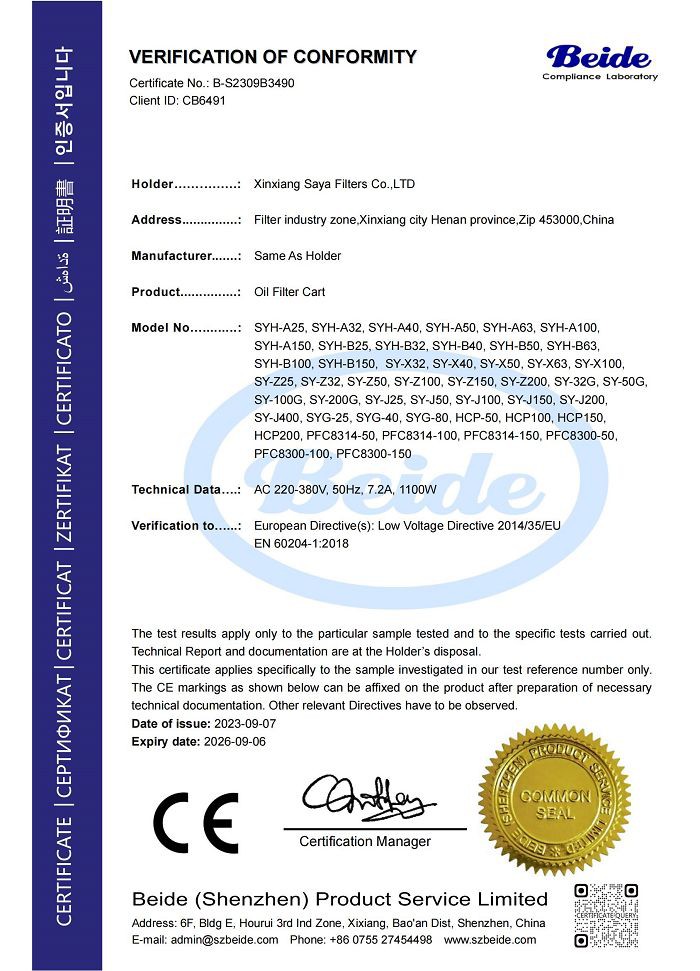
Certifications




FAQ
Q: What is an oil filter cart?
Q: Why is an oil filter cart necessary?
Q: How does an oil filter cart work?
Q: What types of filters are used in oil filter carts?
Q: Can an oil filter cart be used for different types of oil?
Q: What is the capacity of an oil filter cart?
Q: How often should an oil filter cart be used?
Q: How do I choose the right oil filter cart for my needs?
Q: What maintenance is required for an oil filter cart?
Q: Can oil filter carts remove water from oil?
Q: Are oil filter carts easy to use?
Q: What safety precautions should be taken when using an oil filter cart?
Q: How do oil filter carts benefit the environment?
Q: Are oil filter carts cost-effective?
Q: Can oil filter carts be used in extreme temperatures?
Q: How do I dispose of the used oil and filters?
Q: Are there any specific brands known for quality oil filter carts?
Q: Can oil filter carts be used with synthetic oils?
Q: What is the lifespan of an oil filter cart?
Q: Where can I buy an oil filter cart?
We're professional oil filter cart manufacturers and suppliers in China, specialized in providing high quality customized service. We warmly welcome you to buy oil filter cart in stock here from our factory. For price consultation, contact us.
portable filter cart, high viscosity filter cart, portable oil filtration system